3D
Synthwave Drive
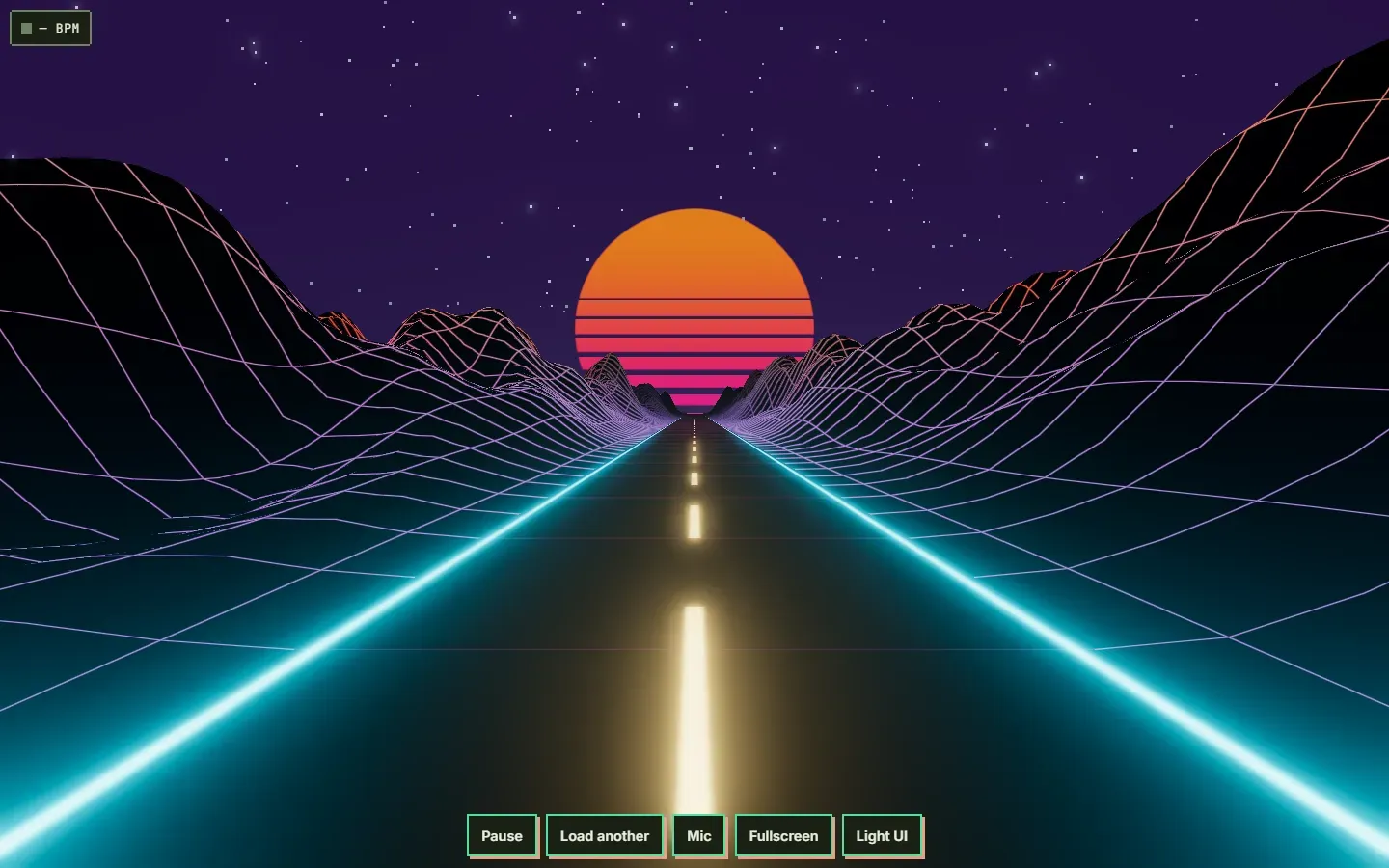
An endless neon wireframe road that reacts to the beat of any song you load.
View live (opens in a new tab)View code (opens in a new tab)
- Role
- Solo designer and developer
- Timeframe
- Oct 2026 - Nov 2026
- 23Commits
- ~1,400Source lines
- 19Unit test cases
- 11E2E test cases
- 100 / 100 / 100Lighthouse a11y / best practices / SEO
Problem
A song should visibly drive a 3D scene in real time, on any GPU, without a loud beat washing the screen out or a slow frame stalling the audio analysis.
Approach
- Beat detection uses spectral flux with an adaptive threshold, and runs on a 16 ms timer instead of requestAnimationFrame so analysis continues when frames are slow.
- Features from the audio feed the shader road, terrain, sun and stars, with bloom added through an EffectComposer and UnrealBloomPass.
- Quality steps down automatically on slow GPUs and retries more slowly after each failed step back up.
Result
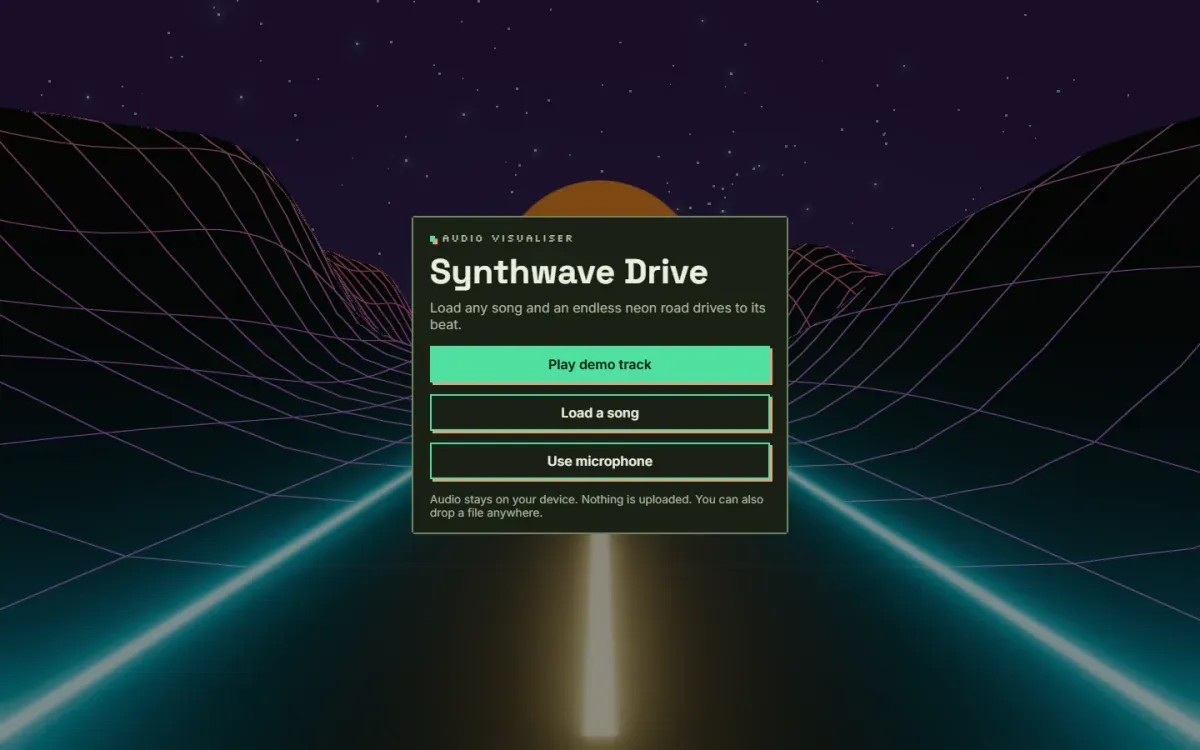
A live, public site on GitHub Pages where a demo track, an audio file or the microphone drives the scene, deployed only after the end-to-end tests pass.
Problem
A song should visibly drive a 3D scene as it plays, on whatever GPU the visitor has. Two things work against that: a strong beat can push bloom to a white screen, and a slow frame can stall audio analysis tied to the render loop.
Approach and decisions
The app is three.js 0.186 with TypeScript and Vite. src/audio holds the analysis: beat detection by spectral flux with an adaptive threshold, feature extraction, surge detection for loud sections, and inputs for a file, drag-and-drop, the microphone or a demo track. src/scene holds the shader road and terrain, sun, stars, bloom and a per-song look. Analysis runs on a 16 ms setInterval rather than requestAnimationFrame, so the beat keeps being tracked when frames are slow.
Quality is adaptive: it steps down when the frame rate stays under about 45 fps for 3 seconds, and the wait before trying a higher tier doubles after each failed attempt.
What broke and how it was fixed
- Beat and surge frames could white out, so bloom is capped (strength at most 1.1, threshold 0.4).
- Quality tiers oscillated; backoff and a profile settle step fixed that.
- Lazy-loading the scene looked like a win but measured worse total blocking time, so it was reverted to an eager import.
- End-to-end runs timed out on slow software-GL runners; a longer timeout and one retry fixed it.
- Gain came from more than one place and frames allocated too much; it now has one source and fewer per-frame allocations.
Results
The site is live on GitHub Pages and the repository is public. It has 23 commits between 2026-10-14 and 2026-11-05, about 1,400 lines of source including the vendored house kit, 19 unit test cases and 11 end-to-end cases, and the deploy runs only if the end-to-end tests pass. A Lighthouse run on 2026-10-15 scored 100 for accessibility, best practices and SEO.
Limits
Beat detection is a heuristic and will miss on music without a clear pulse. Visual quality on weak GPUs is deliberately reduced.